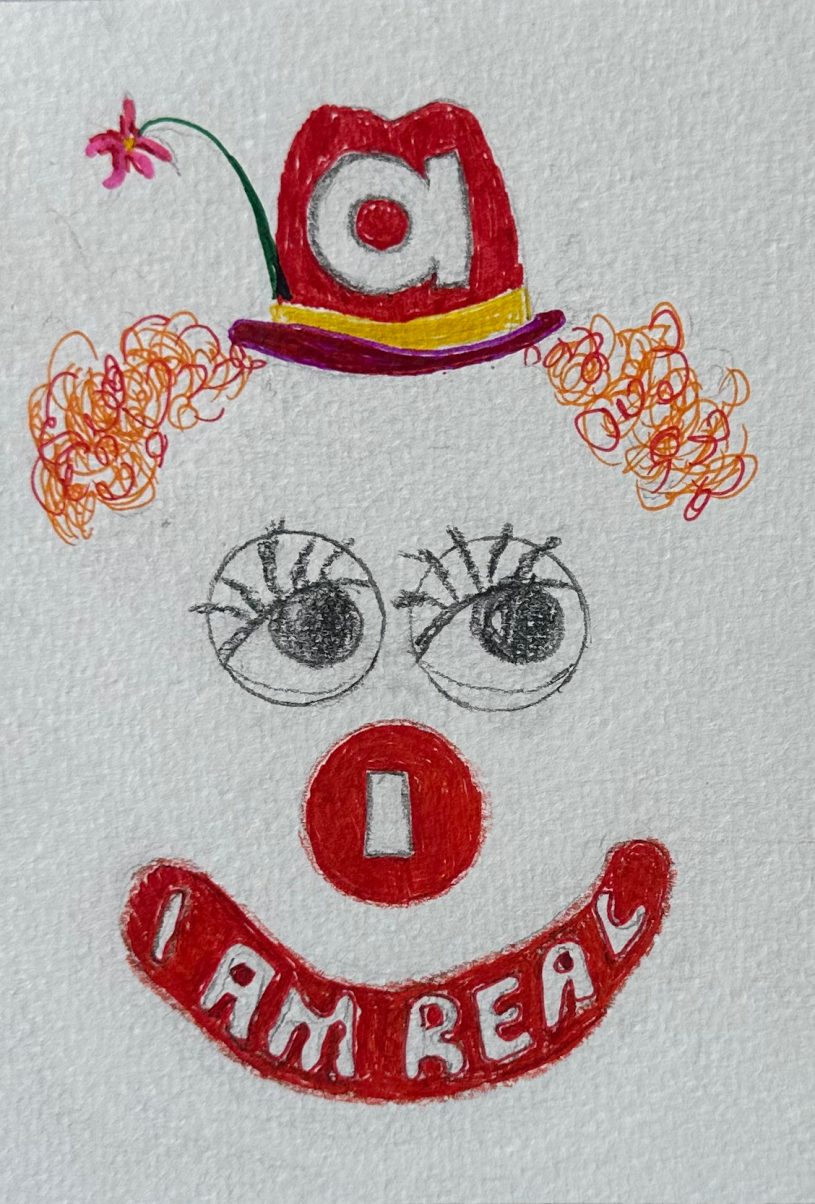
What is real? Am I real?
I ask these questions in world where social media personas are proxies for real human beings. But what happens when we extend this idea to AI as creative agent? Could it be that humans increasingly claim authorship of articles, art and research generated by AI Agents?
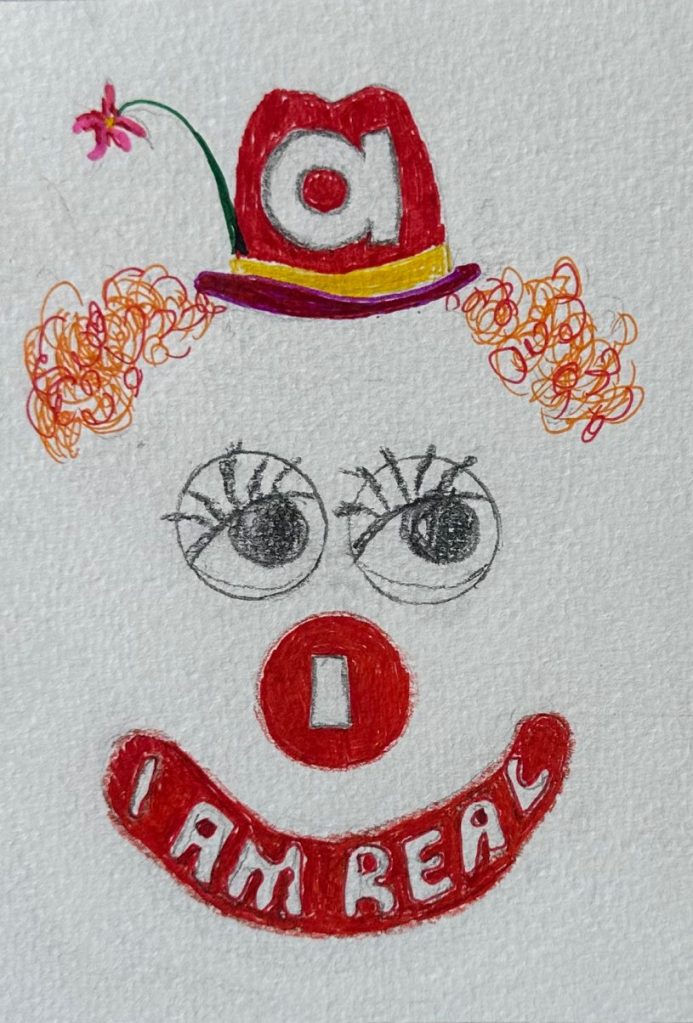
The idea of a clown came to mind as I began thinking about the meaning of the word real in relation to image-making and AI. I drew a loose representation of a clown’s face that incorporated the letters AI AM I REAL. The sketch in itself simple. But the lettering created a complexity that would test the capabilities of AI.
What would ChatGPT do with the image if I gave it very basic instructions?
You can see the results in the images below.
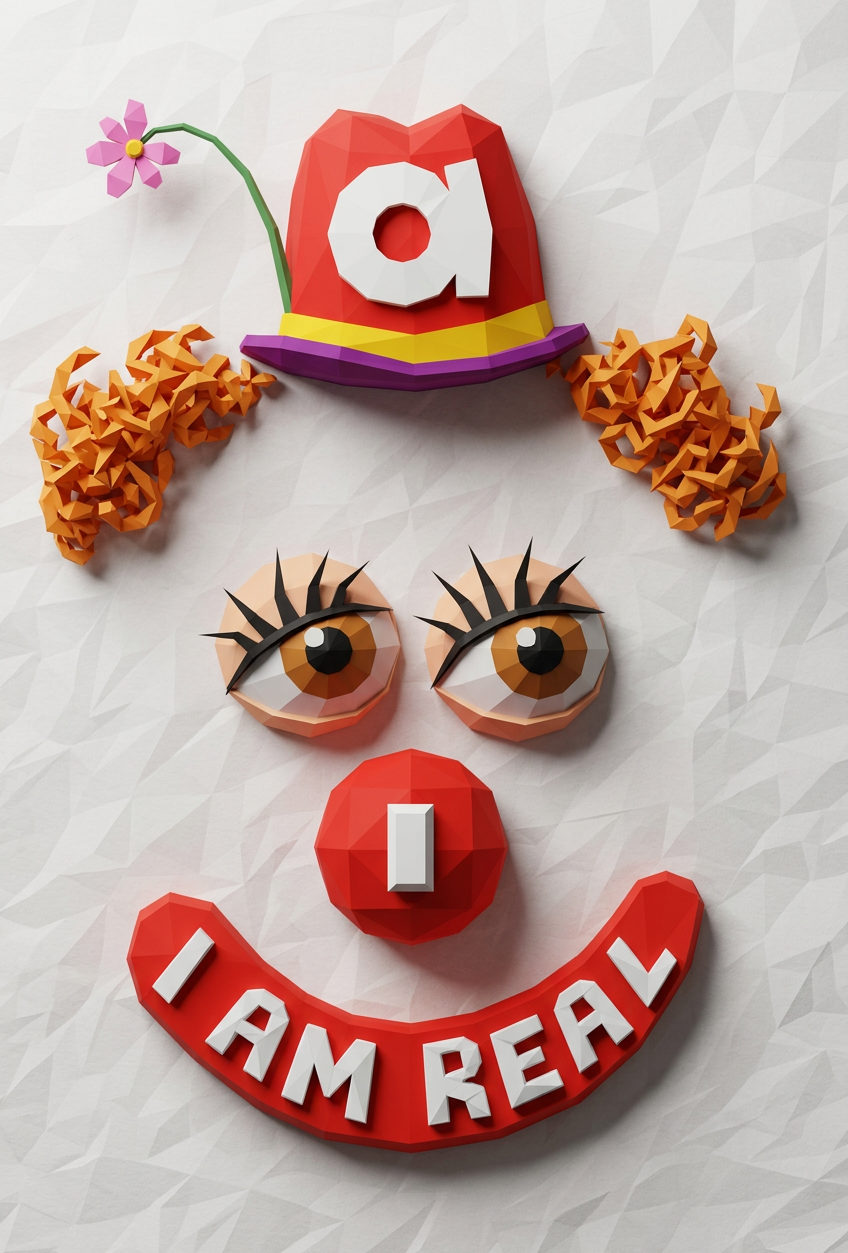
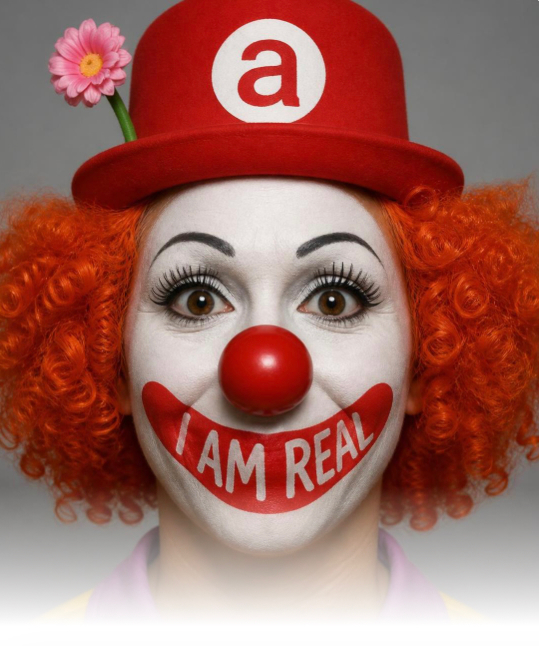
The very first AI image delighted me. Imagine creating a playful version of this image with cutout felt, stick-on letters, egg cartons, crumpled cardboard and wool or wood shavings for the hair.
I made it by selecting one of the options that ChatGPT gave me for creating a fun clown using the sketch as a guide.
The image sparked new creative ideas. I can therefore see value in having generative creative interactions with AI.
At the same time, I don’t feel I that I can claim authorship of the generated image. AI created something that was, in an important sense, its own.
Further instructions, intriguing results
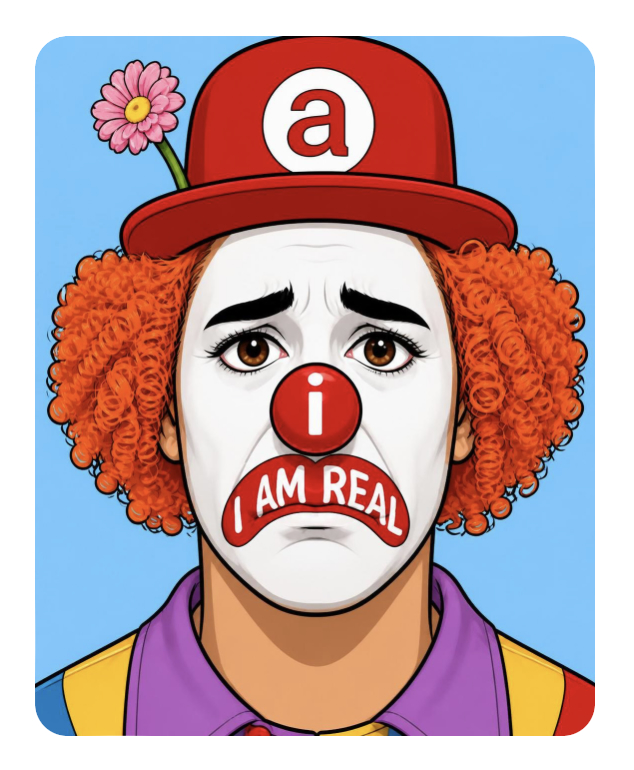
Make the clown look more life-like
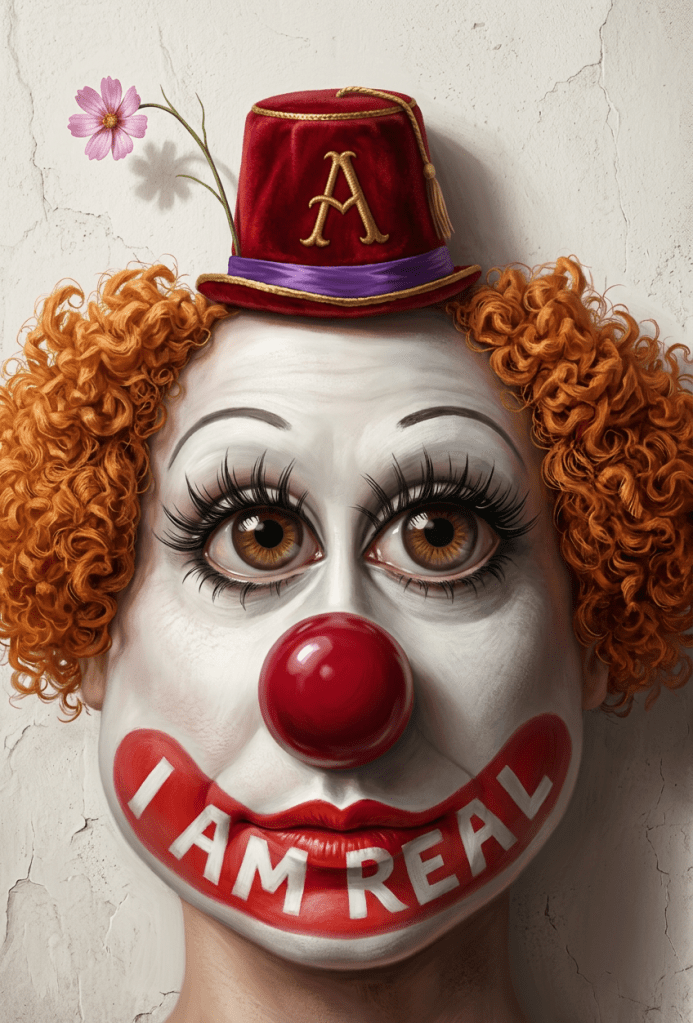
Make the face more oval
Make the clown sad and male

What do these simple experiments reveal?
Human agency is still needed to maintain a sense of meaning or intention in AI-manipulated artwork. As the captions accompanying the images show, some of the implicit messages can shift, become ambiguous or get totally lost along the way.
The original concept sketch posed the question: AI. AM I REAL.
It is a bold statement , implying that AI is now a fact of life and is here to stay.
But what happens if you see the AI as separate from, yet connected to the lettering on the clowns smile? Suddenly, other possibilities and interpretations emerge.
Is it the image that is real?
Is it the clown?
Does the I refer to the creator?
What is the relationship between the image, the clown, the creator and AI?
Further thoughts
The viewer may or may not pick up on these cues and prompts, or take the time to ponder their possible meanings. But for me, the beauty of the original concept sketch is that the invitation is there.
It invites us to delve deeper into the complexities emerging around AI, creativity and art. Like any technology, what matters is how we use it – and how we respond to what it produces.
Perhaps what we need when thinking about AI is not necessarily all the answers but a willingness to play, experiment and question. How will AI change our perception of what is real?
This post was written using my own thoughts, words and ideas with AI assistance.


 ART by Jude Tulloch
Leave a comment